48 hr
Mekong Delta 2-Day Bike, Kayak & Homestay Adventure from Ho Chi Minh City
- Expert local guide
- Small group
- Skip-the-line access
- Free cancellation
Mekong Delta Bike Tour — Village Rides & River Crossings
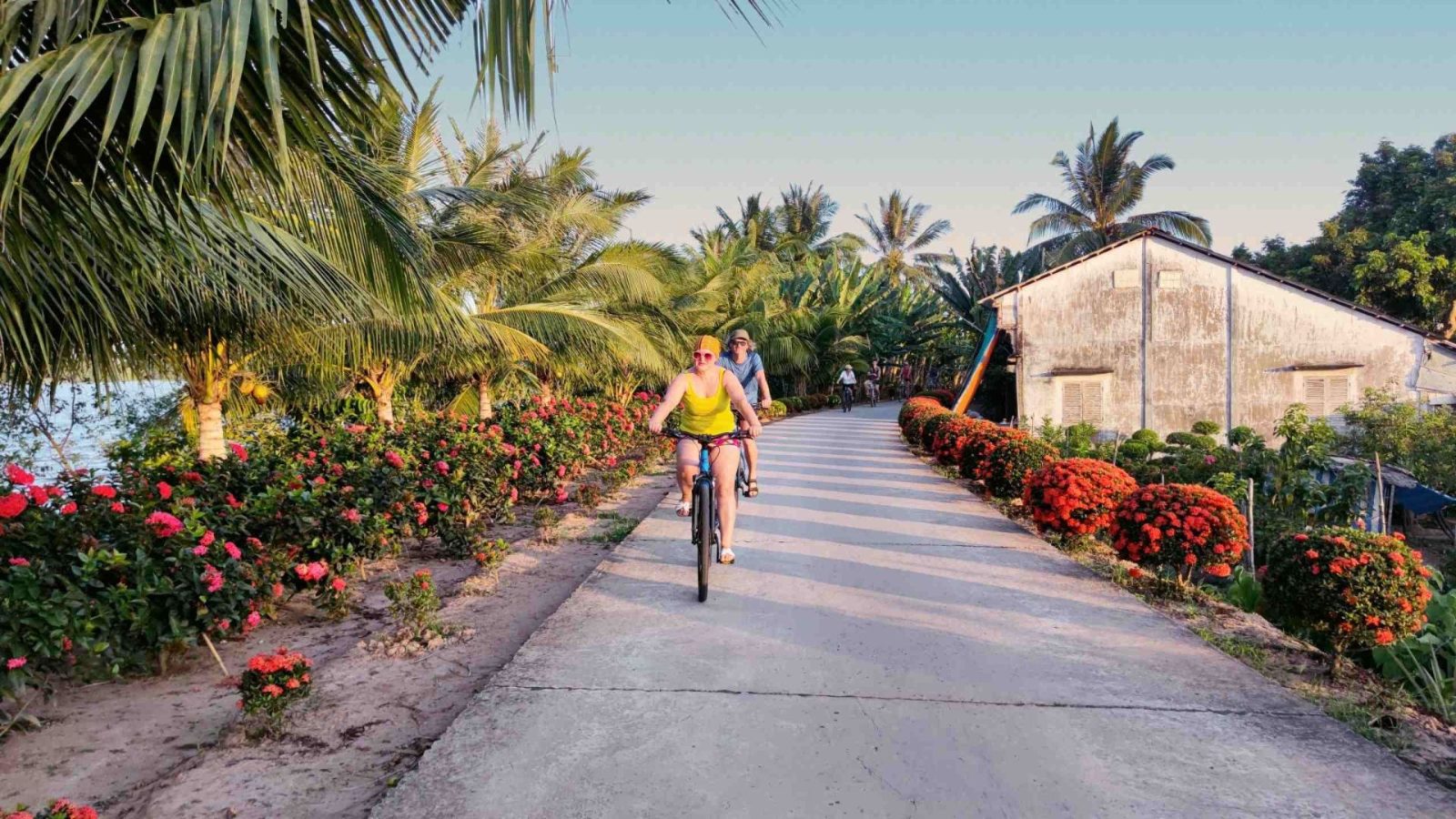
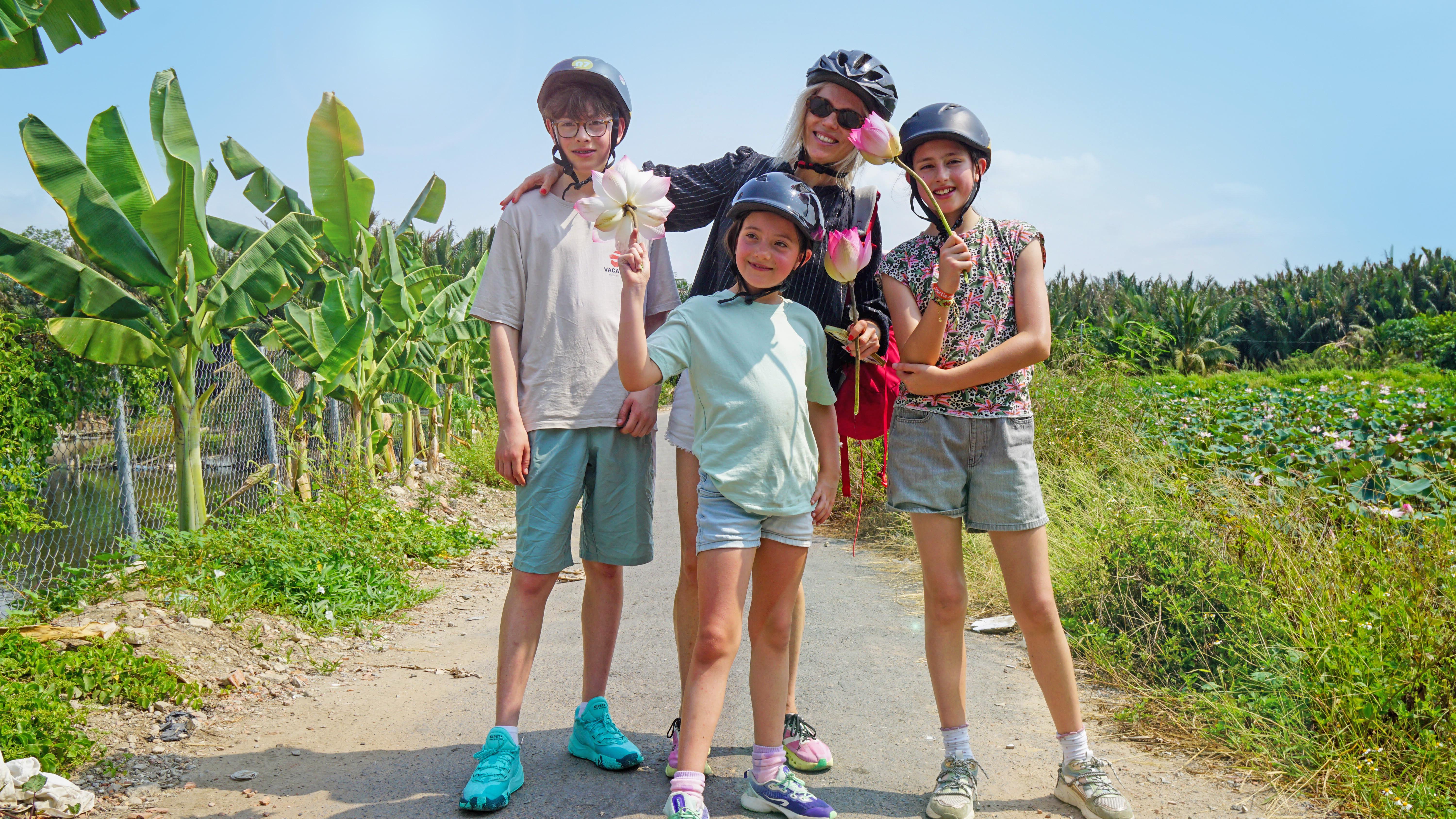
Palm-shaded lanes at first light, brown water beyond the reeds.
Compare fares, pick the fit — all bookings are mobile-voucher and eligible for free cancellation where shown.
48 hr
4 hr
9 hr
Most first-timers with only one day from Ho Chi Minh City lean toward the Mekong Delta bike tour for pace and scenery, while history-focused travelers pick the tunnels; you rarely regret either, but you can't easily do both well in a single day.
|
Top pick Mekong Delta Bike Tour |
Cu Chi Tunnels | |
|---|---|---|
| What you experience | Cycling villages, river boats, orchards | Underground tunnel crawl, war history |
| Physical demand | Moderate — flat cycling, some heat | Moderate — crouching, tight crawling |
| Travel time from Ho Chi Minh City | 1.5–2 hours by road | 1–1.5 hours by road |
| Price | From roughly $25–40 per person | From roughly $15–20 per person |
| Duration | 8–11 hours round trip | 4–7 hours round trip |
| Best for | Scenery, food, slower countryside pace | Vietnam War history, adventure seekers |
| See tickets & prices |
Verdict: Choose the Mekong Delta bike tour for river villages and open-air cycling, and Cu Chi Tunnels for a shorter, history-driven half-day near Ho Chi Minh City.
Hand-picked experiences loved by thousands of travelers
4 hours
Free Cancellation
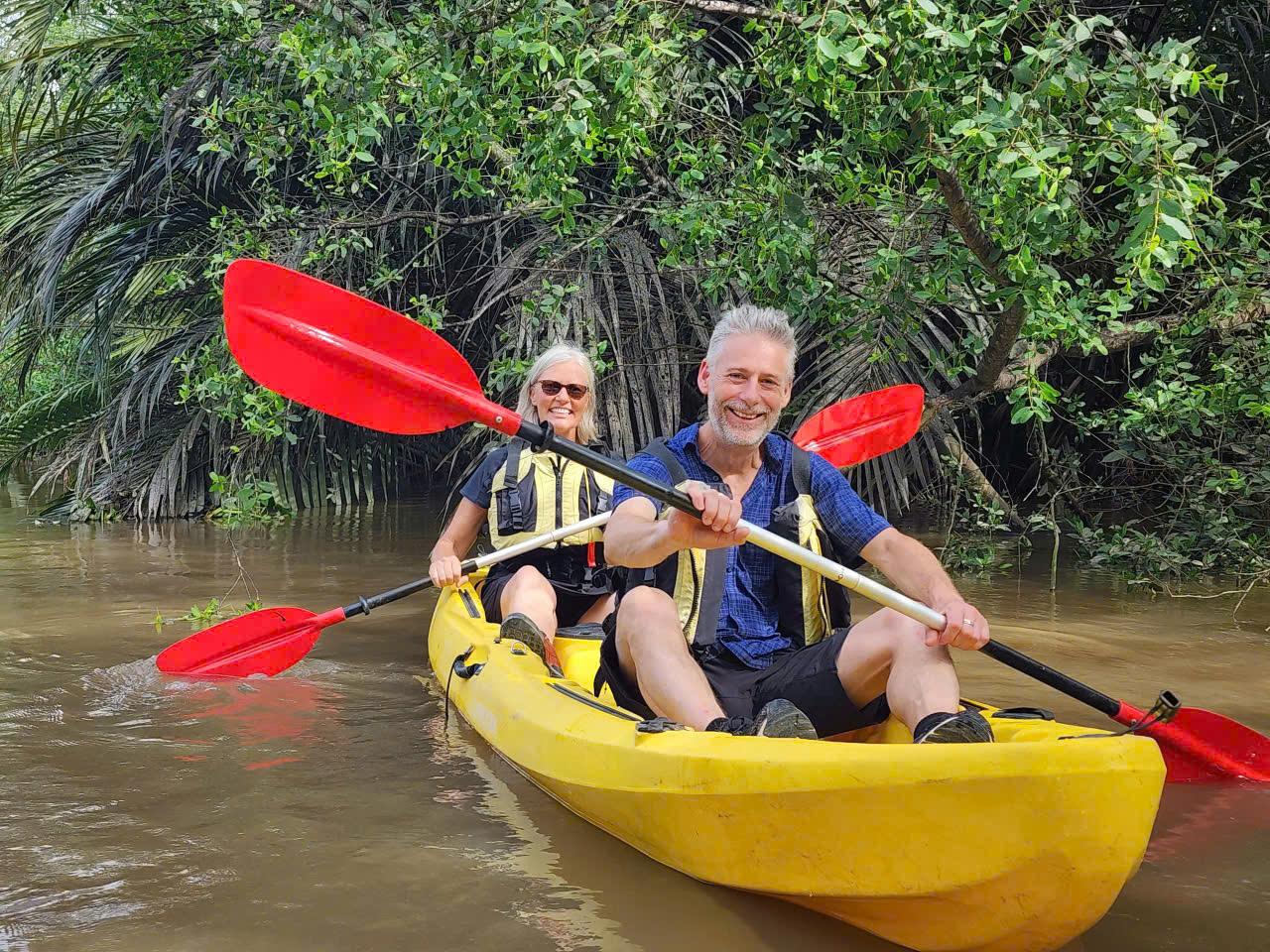
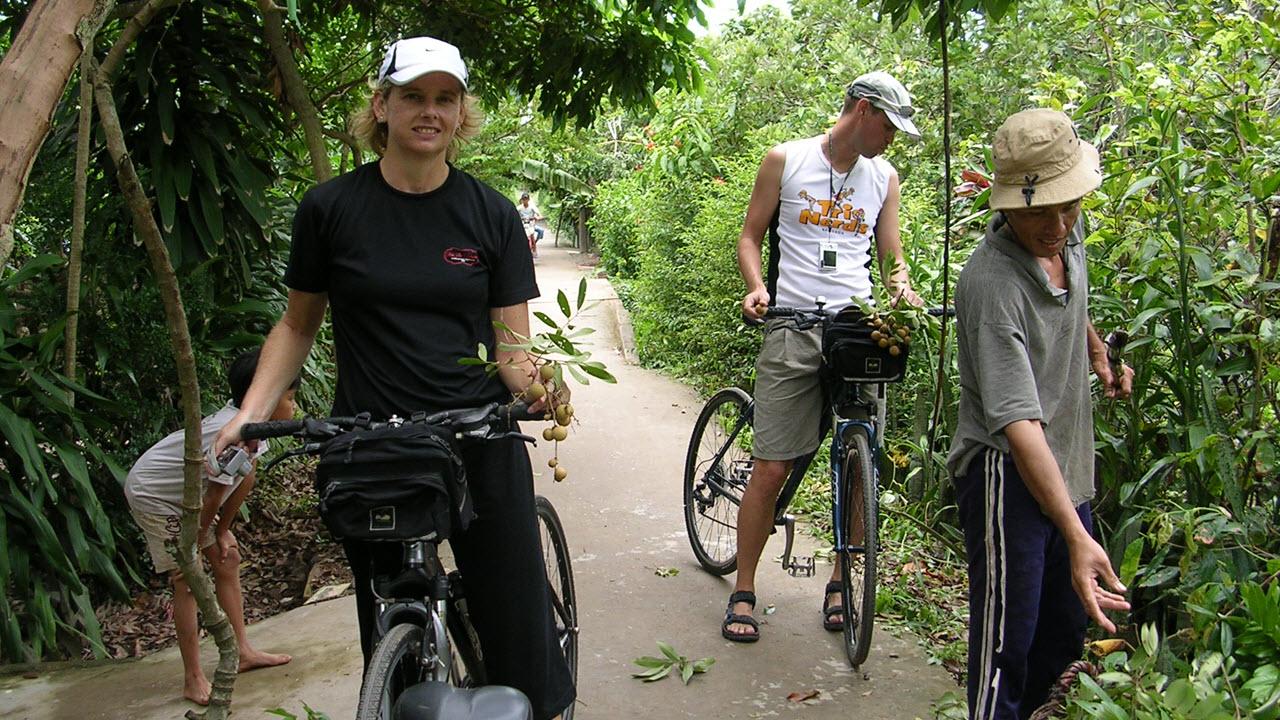
Pedal through Mekong villages, fruit orchards & rice paddies on a 4-hour guided cycling escape.
11 hours
Free Cancellation
Explore wartime tunnels, glide through delta canals, and taste tropical flavors on one epic day trip.
8 hours
Free Cancellation
Pedal through hidden rural trails, coconut groves & riverside villages on a full-day private Mekong escape.
Group meets at Ben Tre, My Tho, Can Tho, or Cai Be and boards a motorboat onto the Ham Luong or Tien River
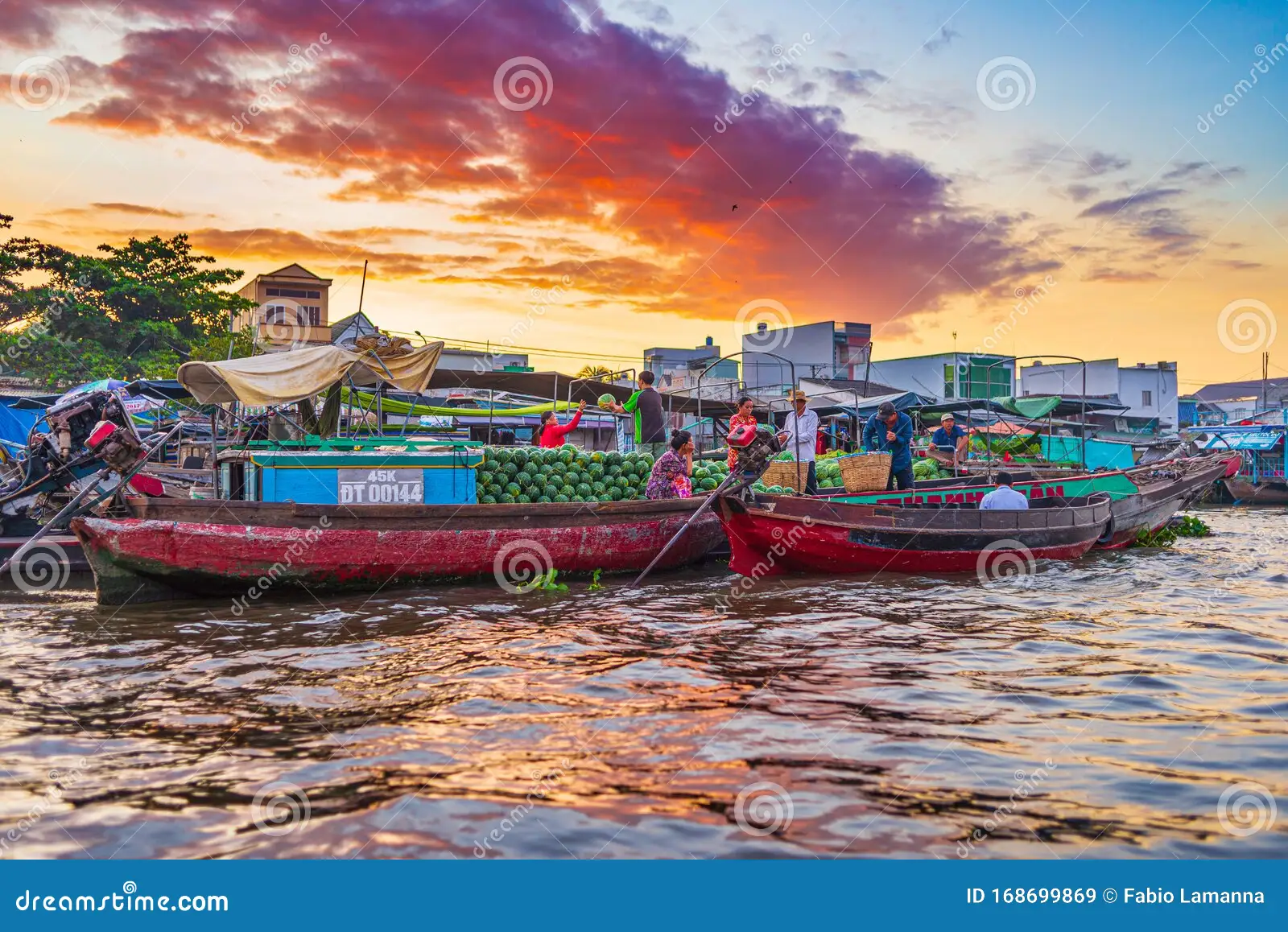
One of the largest wholesale floating markets remaining in the Mekong Delta, busiest between 05:00 and 08:30 when boats trade fruit and vegetables directly on the water. Vendors hang samples of their produce from tall poles so buyers can spot goods from a distance.
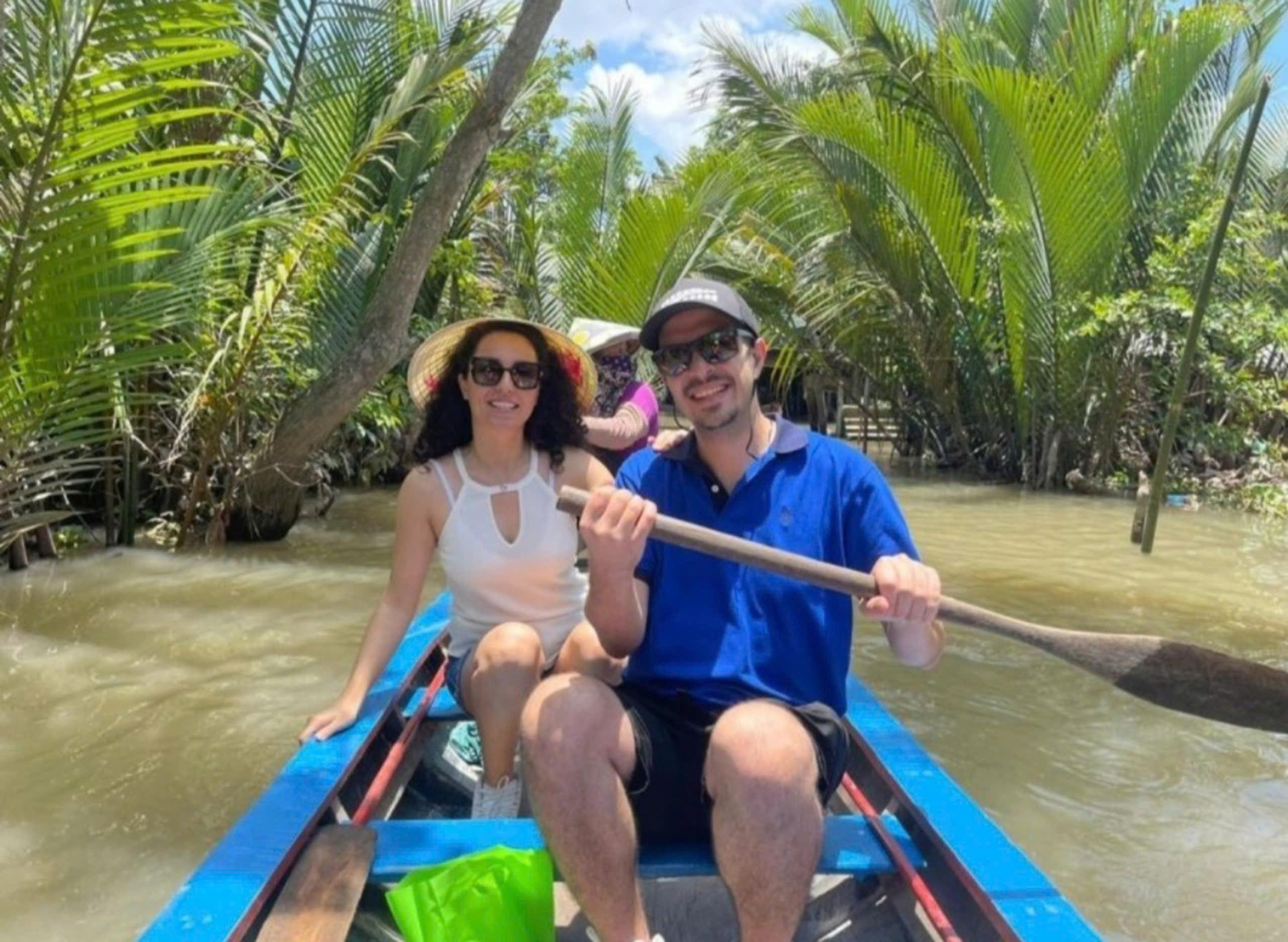
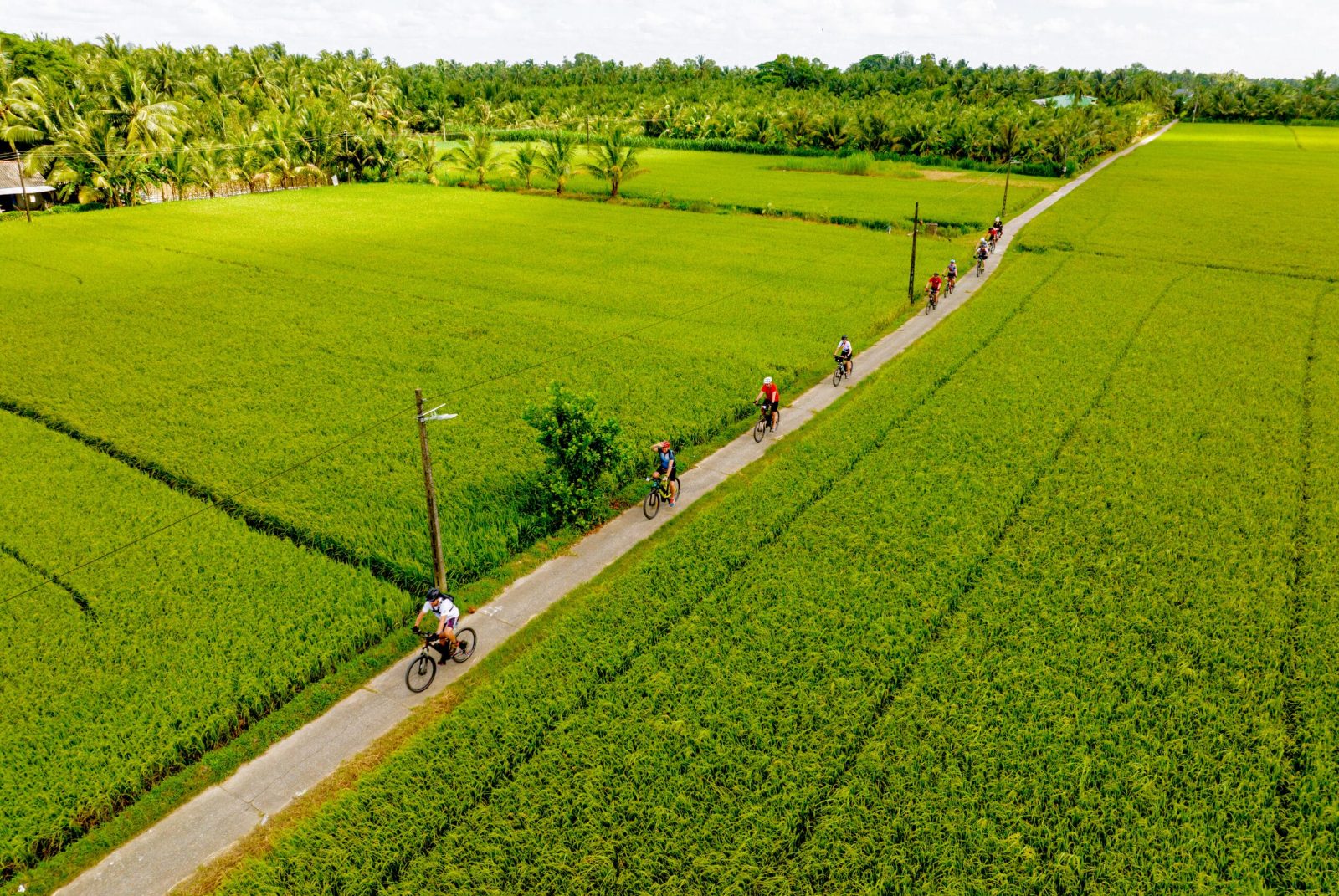
You set off between 07:30 and 10:00, while the village roads are still cool and quiet and the midday heat is hours away. A short ferry or sampan carries you and your bike across the first channel, and then the path narrows to a single concrete ribbon running along the top of a dyke. You pedal past orchards heavy with longan, dismount for a low arched footbridge, and pause where a family is spreading rice-paper rounds to dry on bamboo racks. Mid-morning, you roll into a coconut-candy workshop and watch the paste pulled, cut, and wrapped by hand, still warm. You climb back on and follow the canal, matching pace with a boat poling pineapples toward market. The mekong delta bike tour keeps the legs short and the stops frequent, so you are never far from shade or water. Around noon you leave the bikes and step into a sampan, ducking under low branches as a rower threads the smaller creeks. You stop for lunch beneath a stilt house, then walk a fish farm suspended below the floorboards. By early afternoon you loop back toward the departure town, the same flat ground carrying you home. Gates close at 18:00, but most rides finish well before, leaving the last of the light to the river.
All the details about your upcoming adventure in one place
A mekong delta bike tour rolls along flat dirt lanes and canal-side paths past rice paddies, fruit orchards, and stilt houses, with stops at coconut-candy workshops and local ferries. Guided xe đạp đồng bằng sông Cửu Long rides pair cycling with sampan crossings, so mekong delta bike tour tours suit travelers who want quiet backroads over busy highways. Booking Mekong Delta cycling tickets in advance secures a fitted bike, helmet, and a rider who knows the delta's back lanes.
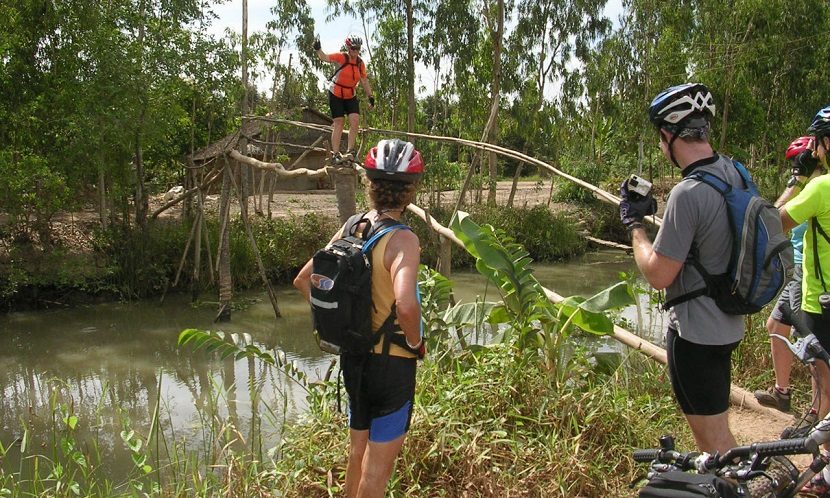
The Mekong drops less than three metres over its final six hundred kilometres, and that near-total flatness is what makes the delta a place best crossed by bicycle. Nine provinces spread across roughly forty thousand square kilometres of alluvial plain, stitched together by a lattice of canals so dense that many hamlets are reached more easily by boat than by road. The land itself is young in geological terms, built grain by grain from silt the river has carried down from the Tibetan Plateau, and it remains the rice bowl of Vietnam, producing more than half the nation's grain and a large share of its fruit. A mekong delta bike tour reads this landscape at the pace it was made for. Narrow concrete paths run atop the dykes, wide enough for a single rider, threading past longan and rambutan orchards, brick kilns shaped like beehives near Vinh Long, and coconut groves that gave Ben Tre its old name, the coconut kingdom. Monkey bridges — single bamboo poles with a thin rail — still span the smaller channels, though many have been replaced by low arched footbridges that riders dismount to cross. The routes favour the back lanes over the highways, so the soundtrack is birdsong, outboard motors, and the clatter of coconut-husk workshops rather than traffic. Departure points cluster around four towns. My Tho, closest to Ho Chi Minh City, opens onto the Tien River and its four named islets. Ben Tre lies deeper among the coconut plantations. Cai Be is known for its riverside church and its shrinking floating market, and Can Tho, the delta's largest city, anchors the western rides near the Cai Rang wholesale market. Each guided delta village ride links short cycling legs with sampan transfers, so the day alternates between pedalling and drifting. What gives these southern Vietnam waterways their character is the intimacy of daily life pressed close to the path. Rice-paper drying on bamboo racks, families tending fish farms suspended beneath their stilt houses, women poling flat boats loaded with pineapples — none of it is staged for visitors, and the well-run mekong delta bike tour tours simply move through it quietly. The delta faces real pressures now, from upstream dams to saltwater intrusion creeping further inland each dry season, which lends a certain urgency to seeing the working waterways while their rhythms hold. Cycling remains the least intrusive way to meet the region on its own terms, close to the water, slow enough to notice, and carried by the same flat ground the river laid down.
The Mekong drops less than three metres over its final six hundred kilometres, and that near-total flatness is what makes the delta a place best crossed by bicycle.
Lightweight, breathable clothing that covers shoulders and knees is practical for a mekong delta bike tour, since several stops include small pagodas such as Vinh Trang Pagoda where modest dress is expected. Closed-toe shoes or sports sandals work better than flip-flops for pedaling on uneven dirt paths and boarding sampans.
A small daypack is sufficient for a mekong delta bike tour, as larger luggage usually stays with the support van or minibus at the departure point in Ben Tre, My Tho, or Cai Be. Keep valuables in a zipped, water-resistant pouch since sampan transfers between canal stops involve stepping in and out of low, narrow boats.
Photography is welcome throughout the mekong delta bike tour, including at coconut candy workshops, orchard stops, and floating markets, though it's polite to ask before photographing vendors or families up close. Bring a strap or dry bag for cameras during sampan crossings, since splashes are common on narrow canals.
Children old enough to ride a bicycle independently, generally around age 8 and up, can join most mekong delta bike tour itineraries, with tandem or trailer options available from some operators for younger kids. Life jackets are provided for sampan and canal-boat segments.
The mekong delta bike tour route uses flat but sometimes unpaved dikes, narrow footbridges, and low sampans, which makes it difficult for wheelchair users or those with limited mobility. Operators can usually swap cycling segments for van transfers on request, but canal boat boarding still requires some balance and a step down into the boat.
Bottled water and packaged snacks may be carried on bicycles and boats, but glass containers are discouraged on sampans due to limited space and tipping risk. Locally grown fruit sampled at orchard stops is included in most itineraries and does not need to be brought separately.
Village roads quieter before 09:00
Midweek departures often less crowded
Weekend groups start booking up
Busiest day, book ahead
Daily hours
07:00–18:00 every day of the week;location
Car · 1.5-2 hr from HCMC · Private car often bundled in tour price
A private car or minivan from Ho Chi Minh City to My Tho takes roughly 90 minutes via Highway 1A, while Ben Tre and Cai Be add another 30-45 minutes.
Public transport · 3.5 hr to Can Tho · Around 165,000 VND (~6 USD) one way
A Phuong Trang (Futa) bus running hourly from Ho Chi Minh City to Can Tho covers the wider Mekong Delta region.
Boat · 20-45 min per crossing · Usually included in tour package
Local motorboats and sampans connect departure piers in Ben Tre, My Tho, and Cai Be to inner canal stops.
Bike · 1.5-2 hr of riding · Included in most tour packages
Bicycles are provided at the departure point for the cycling segments of the route.
Most Mekong Delta bike tour operators allow free cancellation up to 24-48 hours before departure with a full refund, since there is no entrance fee (0 USD) tied to the multi-stop itinerary itself. Late cancellations or no-shows on the day of departure are typically non-refundable because boats and bicycles are pre-booked for the group.
Recommended time
Half a day (4-6 hours)
A typical mekong delta bike tour runs half a day, covering transfer to the departure point, 40-90 minutes of village cycling on quiet concrete paths, and a stop at a riverside or floating market, while full-day itineraries stretch to 8-9 hours by adding a second market, an orchard stop, and lunch. Leaving within the 07:30-10:00 window keeps riders ahead of the midday heat and gets bikes on the road before village lanes and market boats fill up. Add an hour if your route includes a floating market crossing by boat, since traffic on the water peaks mid-morning; subtract time by sticking to a single village loop. There are no ticket queues to plan around, since boarding is by scheduled group departure rather than a ticket line.
Crowd levels through the day
Weather · crowds · average price — dots go green to amber to red as each metric rises.
December through April brings the driest, coolest weather for a mekong delta bike tour, with minimal rainfall making canal paths firmer and more comfortable to ride. This period sees the highest visitor numbers, especially around Tet in February.;Peak fruit season (May-Aug)
Departures between 07:30 and 10:00 avoid the harshest midday heat and catch village roads before they get busy with local traffic.;Pack light for boats
Ben Tre City, Ben Tre Province, Vietnam
Common start for coconut-country cycling routes
Get directionsThe Mekong Delta owes its shape to water moved by human hands. From the seventeenth century, Vietnamese settlers pushing south into former Khmer lands cut the first shallow channels between the river's nine mouths. In 1819, under Emperor Gia Long, laborers completed the Vinh Te Canal near Chau Doc, an eighty-seven-kilometer waterway dug largely by hand over five years. It linked the Hau River toward the Gulf of Thailand and fixed the frontier with Cambodia. French colonial engineers arrived after 1867, when Cochinchina fell under direct rule. They brought dredges. Between 1900 and 1930, mechanical excavation carved hundreds of kilometers of straight canals across the western plain, draining the Plain of Reeds and the Ca Mau peninsula. Rice acreage tripled. By the 1930s the Delta shipped over a million tons of rice yearly through Saigon, making it the region's granary. The mekong delta bike tour now threads embankments that were spoil banks from those French dredges. The canals reordered village life. Homes lined the water; markets floated where channels met. Brick kilns rose at Cai Be and Vinh Long, and coconut-candy workshops clustered around Ben Tre. These orchards, kilns, and stilted houses are what a modern Mekong Delta cycling tour passes today, the traditional rhythm surviving beside the concrete bridges built after 2000. War tested the landscape. Bombing and defoliation between 1965 and 1972 scarred the western canals, yet the earthworks held. Post-1986 economic reform, Doi Moi, revived rice exports and reopened the waterways to trade. Cycling routes were formalized in the 2010s as operators mapped quiet lanes along the dikes. A booking today, whether framed as mekong delta bike tour tickets or a simple day pass, buys passage through this engineered geography. The mekong delta bike tour tours and shorter Mekong village tour options both follow the old canal grid, and a single mekong delta bike tour tour still traces engineering four centuries in the making.
Vietnamese settlers cut the first canals between the Mekong's nine river mouths.
The hand-dug Vinh Te Canal near Chau Doc is completed under Emperor Gia Long.
France takes direct rule of Cochinchina, opening the era of colonial waterworks.
French dredges carve straight canals, draining the Plain of Reeds and tripling rice land.
The Delta ships over a million tons of rice yearly, becoming Vietnam's granary.
Wartime bombing and defoliation scar the western canals, though the earthworks endure.
Doi Moi reforms revive rice exports and reopen the waterways to trade.
Operators formalize cycling routes along the old canal dikes and village lanes.
A mekong delta bike tour with children works best as short, flat rides between boat legs rather than a full day in the saddle, since operators can size bikes down but young riders still tire on canal-side paths. Most groups run day-trip loops from Ben Tre, My Tho, Can Tho, or Cai Be, which makes it easy to swap cycling for a sampan ride whenever kids need a break.
Tour operators generally hold smaller frames and can fit children once you share the child's height at booking, so confirm this a few days ahead rather than assuming one arrives on site.
Adults on these routes often cover 30–90 km per day, but kids do far better on 5–10 km segments between rest and boat transfers, so ask the guide to shorten the loop rather than push through the full itinerary.
Riding between 07:30–10:00 avoids the worst midday sun on the open paddy-field tracks, and kids should carry their own water bottle and refill often since shade is limited along the canals.
Swapping a cycling leg for a sampan crossing or a tandem with an adult keeps younger children engaged without the fatigue of narrow, bumpy village paths.
Build in stops every 20–30 minutes at orchards or roadside stalls so children can rest off the bike, since the mekong delta bike tour circuit has few formal rest points otherwise.
Toilets and shade are mostly limited to village homestays and market stops, so plan breaks around these rather than expecting facilities along the open road.
There is no single restaurant strip on a mekong delta bike tour; eating happens in stages, at family-run workshops and garden stops along the Ben Tre, My Tho, Can Tho and Cai Be routes, with a set lunch usually built into the day.
Along the Chet Say River canal near Ben Tre, watch candy pulled and cut by hand, then sample warm pieces with fresh coconut water; a quick stop, rarely crowded before 10am.
A shaded garden stop on Thoi Son (Unicorn) Islet for honey tea, banana chips and a look at the hives; pairs with a fruit orchard visit and light folk music, best as a short break mid-ride.
Seasonal longan, jackfruit or dragon fruit served in a garden setting on the Tien River islets near My Tho; casual bench seating, fine for a fast stop between the boat and bike legs.
The typical mid-tour lunch: a multi-dish Southern Vietnamese set menu (spring rolls, grilled fish, morning glory, rice) at a family or riverside restaurant, with vegetarian options on request; can be busy around noon.
A brief stop near Cai Be floating market to watch pop rice and rice paper made by hand, with samples offered; good for a five-minute break rather than a sit-down meal.
Real experiences from real travelers
Our mekong delta bike tour started before the heat and wound along narrow dyke paths shaded by coconut palms. We crossed three of those wobbly monkey bridges and stopped at a family orchard for rambutan straight off the tree. The guide kept the pace easy so nobody felt rushed.
Getting to Cai Rang floating market by boat and then cycling the back lanes was the right order. The sampans piled with pomelo at first light stayed with me all day. Bring a dry bag because the canal spray is real.
The Cai Be riverside cycling route was flat and gentle, though the midday humidity crept up fast. I appreciated that our guide carried extra water and pointed out the brick kilns along the Mekong. A slightly earlier start would have helped.
Pedaling between longan trees and stopping at a coconut candy workshop made this feel local rather than staged. The rice-noodle lunch beside a canal was simple and fresh. Our mekong delta bike tour guide clearly knew every farmer we passed.
I was nervous about the distance but the Mekong Delta cycling tour used quiet farm tracks with almost no traffic. Water buffalo watched us from the paddies and the sugar-palm silhouettes at the end were lovely. Helmets and decent bikes were provided.
Skipping the packaged bus crowd for a mekong delta bike tour tour meant we reached villages the big groups never see. We ferried across a branch of the river and rode the dykes near Vinh Long. Book the small-group option if you can.
Recent rain left a few of the red-dirt lanes slick, so grip mattered on the monkey bridges. Still, the floating market and the pomelo garden made the effort worth it. Check that your mekong delta bike tour tickets include the boat transfer.
Riding the raised paths between flooded rice fields near Cai Be felt endlessly green under the late sun. We tasted honey tea at a bee farm and elephant-ear fish for lunch. A relaxed Mekong Delta landmarks day on two wheels.
The logistics were smooth from the ferry to the orchard stops, and the guide adjusted the loop when one rider tired. Cycling the sugar-cane lanes at golden hour was the highlight. Among the various mekong delta bike tour tours listed, the small-group one suited us best.
We left early and the canals were mirror-still, mist lifting off the water as we crossed the first bridge. Fresh coconut and a slow pace made the tour du delta du Mekong à vélo feel unhurried. Comfortable saddle, friendly guide, quiet roads.
Everything you need to know for your journey
Daily departures run from 07:00 to 18:00, seven days a week, with most groups starting between 07:30 and 10:00 to avoid midday heat.
There is no single entrance fee; the mekong delta bike tour is a multi-stop itinerary rather than a ticketed site, so pricing covers the bicycle, boat transfers, and guide rather than a gate fee.
Most itineraries depart from Ben Tre, My Tho, Can Tho, or Cai Be, with boats and bicycles waiting at riverside piers in each town.
The route includes unpaved dikes and low sampans that require some balance, so it is not well suited to wheelchair users, though some operators can substitute van transfers for cycling segments.
Bring a sun hat, sunscreen, insect repellent, a reusable water bottle, and closed-toe shoes suited to dirt paths and boat boarding.
Photography is welcome at coconut candy workshops, orchards, and floating markets, though it's courteous to ask before photographing vendors directly.
December through April is the coolest, driest window, while May through August brings peak tropical fruit season alongside more frequent afternoon rain.
Yes, children roughly age 8 and up who can ride independently are generally welcome, and life jackets are provided for boat segments.
Lunch typically features regional dishes such as grilled elephant-ear fish, spring rolls, and fresh tropical fruit sampled straight from orchard stops.
Departure points are reachable by private car or minivan from Ho Chi Minh City in 1.5 to 2 hours, or by public bus to Can Tho in about 3.5 hours.
Most operators allow free cancellation 24-48 hours before departure, with late cancellations or no-shows typically non-refundable.
Vinh Trang Pagoda in My Tho and the Cai Rang or Cai Be floating markets pair naturally with a bike tour, since they sit along the same canal and river routes.
A 19th-century Buddhist pagoda in My Tho blending Vietnamese, French, and Khmer architectural styles. Its garden holds large statues, including a reclining Buddha, and is a common stop before or after canal segments.
A cluster of hotels near Ninh Kieu Wharf offering easy access to early-morning floating market boat departures.
Join thousands of happy travelers who have discovered this incredible experience
Book Your Experience Now